From CISO to CIO: Building the Trusted Strategic Partner
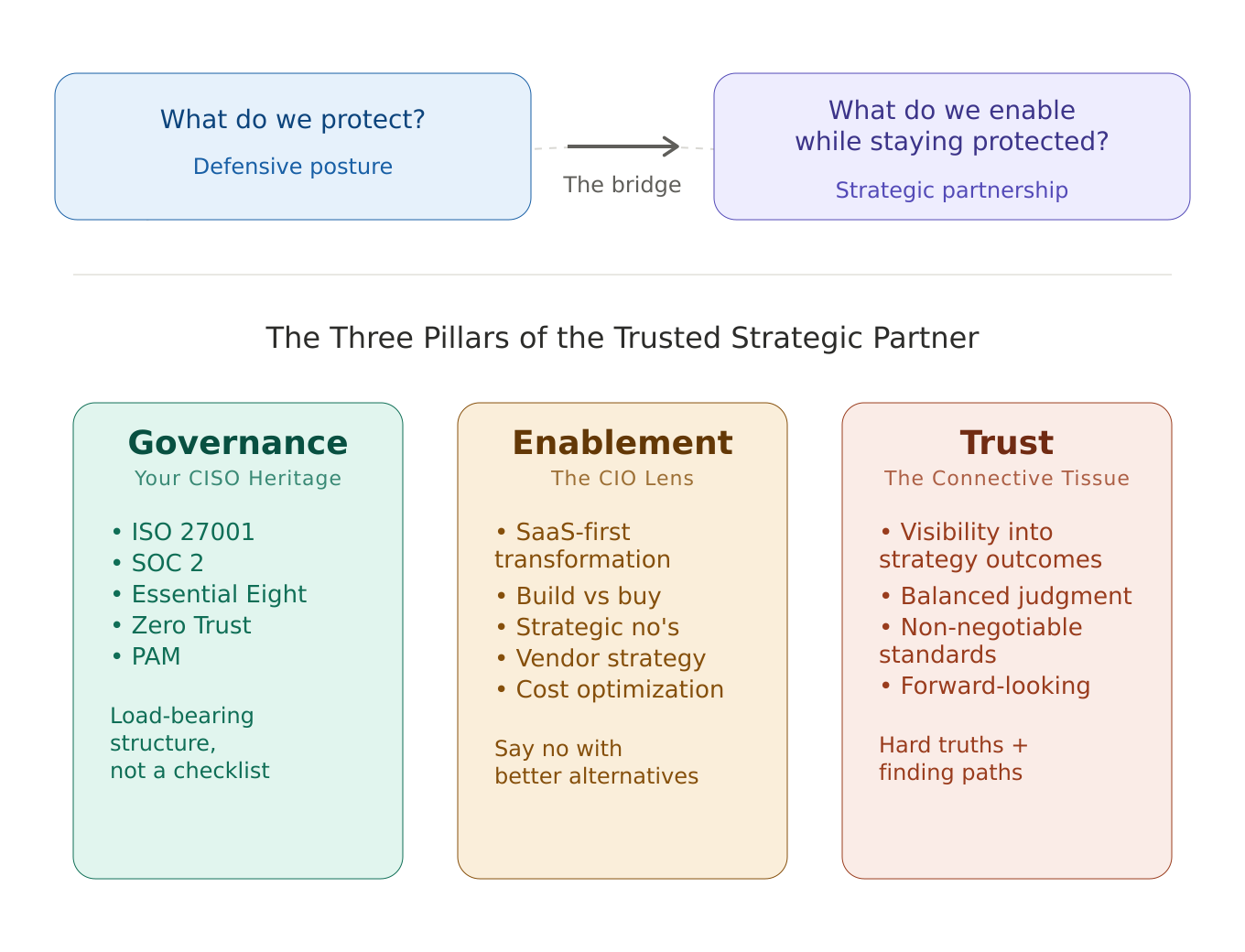
The CISO role is built on a single foundational question: What do we protect?
You learn to think in terms of perimeters, blast radius, control failure modes, residual risk. You build frameworks around the assumption that people will make mistakes, systems will fail, and threats will find the gaps you missed. It is a posture of vigilance. It is defensive.
It is also essential. And most CISOs become very good at it.
But there is a moment in every security leader’s career when the question changes. Not disappears—changes. You stop being asked only “Is this secure?” and you start being asked “Can we build this? And will it win in the market?”
The question expands from “What do we protect?” to “What do we enable while staying protected?”
That expansion is the bridge from CISO to CIO.
The Skill Gap
Here is what a CISO gets right: accountability for risk posture. You understand the cost of failure because failure has consequences for the entire organisation. You think in terms of frameworks—ISO 27001, SOC 2, Essential Eight, regulatory alignments. You build governance structures that scale. You say no to bad ideas and explain why in business terms.
CISOs are also, often, the adults in the room. You’ve learned not to chase the newest security tool because it’s shiny. You’ve learned that discipline beats complexity. You’ve learned that standards, held consistently, are the only thing that separates high-trust organisations from ones that operate in perpetual crisis-management mode.
But here is what a CISO may not yet have built: business partnership at the executive table.
The question “Is this secure?” is necessary. It is not sufficient. A CIO must also answer: “Is this the right direction for the business? Who owns this outcome? What is the cost of not moving? What is our competitive position if we wait?”
A CISO says: “Here are the risks.” A CIO says: “Here are the risks, and here is how we move forward anyway—with eyes open.”
The shift is subtle but material. It is the difference between defending the castle and building the bridge that connects the castle to the marketplace.
Three Pillars of the Trusted Strategic Partner
The most effective CIOs I have observed operate across three distinct domains. Holding all three simultaneously is where the value lives.
First: Regulatory-Ready Governance. This is your CISO heritage. You do not abandon it. You embed it so deeply into how the organisation builds and operates that it becomes invisible—a load-bearing structure, not a checklist. You align your technology strategy to frameworks like ISO 27001, SOC 2, and Essential Eight not because auditors require it, but because these frameworks capture hard-won lessons about how organisations fail. You use them as a lens for building antifragile systems.
But you hold this posture lightly enough that it does not become a speed bump. Governance that requires heroic effort to comply with is governance that will be circumvented. The best governance is the kind that is easier to follow than to break.
Second: Technology Enablement. This is where the CIO lens diverges from the CISO lens. You must understand the business deeply enough to know what the organisation is trying to build, where the bottlenecks are, and where technology can unlock value. You ask questions like: What are we trying to achieve? Where do we spend capital today that could be redirected? What vendor relationships are load-bearing, and which are legacy?
This requires a different kind of strategic thinking. It requires understanding SaaS-first transformation—not as a checklist, but as a fundamental shift in how organisations build, scale, and maintain their technology estate. It requires knowing when to build, when to buy, when to integrate, and when to say no.
Enablement is not the same as saying yes to everything. The best CIOs say no frequently. But they say no with alternatives. “We cannot do that because it does not align with our security posture and our architectural principles. But here is what we can do instead—and it will actually solve your problem faster.”
Third: Stakeholder Trust. This is the connective tissue between governance and enablement. A CISO builds trust by being reliable—by understanding risk deeply and communicating it clearly. A CIO builds trust by being reliable and forward-looking. You become the person the CEO knows will tell them the hard truth, but also the person who will find a path forward.
Trust, at the CIO level, is built through:
- Visibility: The board understands your technology strategy, not because you’ve explained it to them three times, but because it is connected to business outcomes they care about.
- Judgment: You make decisions that balance security, cost, speed, and innovation. You don’t optimise for one variable. You optimise for the system.
- Non-negotiable standards: You have clear lines. These are not arbitrary. They exist because you have seen the cost of crossing them. And you hold them even when it is inconvenient.
The Architecture of the Shift
How do you make this transition without losing the rigor that made you effective as a CISO?
The answer is to build the same way you do in security: with architecture, not slogans.
Your governance structures remain non-negotiable. You use them to create safety rails around what the organisation can build. Zero Trust is not a marketing term; it is an architectural principle that shapes how you design infrastructure. PAM (Privileged Access Management) is not a compliance checkbox; it is the foundation of access control that allows you to scale with confidence. An M365 Copilot acceptable use policy is not about blocking tools; it is about understanding where data lives, what an agent can see, and building guardrails that enable innovation without exposing sensitive information.
Your team structure reflects your priorities. If you separate IT Operations from Cybersecurity, it is not because they are enemies. It is because they have different optimisation targets. Operations wants uptime, efficiency, and user enablement. Security wants to understand risk, govern access, and maintain compliance posture. These goals are not opposed, but they require different lenses. A CISO at the CIO level understands that structural clarity prevents political conflicts from damaging both functions.
Your decision-making frameworks become visible to the board. When you propose a D365 transformation, you do not present it as a security initiative or an operations initiative. You present it as a business transformation that reduces legacy cost, improves data portability, and enables a SaaS-first architecture. You explain the security principles that underpin it. You explain the operational benefits. You connect the decision to strategic outcomes the board cares about.
This is where many CISOs stumble. You are used to explaining security in terms of risk. Boards care about risk, but they care about it in service of business outcomes. The CIO language is: “This reduces our cost of compliance, improves our agility, and positions us to scale faster than our competitors.”
The Real Transition
The moment you move from CISO to CIO is not the moment your title changes. It is the moment you stop asking “Is this secure?” first and start asking “Is this the right move for the business—and if it is, how do we do it securely?”
The order matters. The first question is defensive. The second is strategic.
A CISO who becomes a CIO in title only but keeps asking the questions in the old order will fail. They will be seen as a blocker, not a strategic partner. They will watch initiatives go around them instead of through them.
A CISO who truly makes the transition asks the business question first. They hold the security posture alongside it, not in opposition to it.
This is harder than it sounds. It requires letting go of the comfort of being the person who says no. It requires becoming the person who says “yes, and here is how we build it so the board can sleep at night.”
But this is what a trusted strategic partner does. They do not defend the old castle. They build the new one—stronger, faster, and built to scale.